Me and You and Everyone We Know: Second Take
by Daniel Hui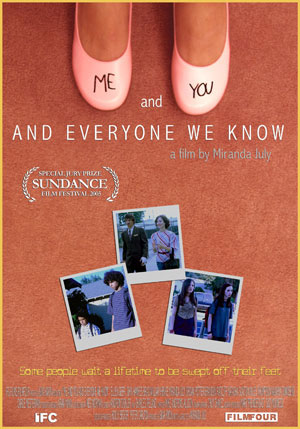
To see Miranda July's debut feature and critical darling Me and You and Everyone We Know as the typical quirky American independent feature is perhaps missing her point, or attaching too much importance to an outwardly lightweight and effervescent movie that thrives on succeeding moment after euphoric moment with life-affirming meaninglessness.
The post-American Beauty-Solondz-Anderson American indie is typified by one-note quirky characters who are used to portray a suburban milieu that is wacky and unusual. Their quirks are used to provide the ironic wit to sugarcoat (sour-coat?) plots and relationships that are ultimately familial melodrama at its core - about dysfunctional families finding ways to bond with each other.
I think Miranda July on the other hand, starts from regular (or ill-defined?) people whose characters are not defined by their idiosyncracies or backstories (save maybe for John Hawkes' character, whose symbolism can be a bit heavy-handed at times).
 Rather, they seem more like Linklater's characters, who try to find wonder and innocence within lives of banal ordinariness. July's quirkiness arises from the need to see the world differently from its normal colors - to see a kaleidoscope of the absurd and whimsical in the mundane. As such I think she's more like a Peter Greenaway, only interested in seeking these moments of wonder and child-like discovery, even if they defy narrative or thematic cogence, or more (or less) importantly, 'meaning.'
A typical American indie starts with a view of distorted/dysfunctional suburbia at its core and has its characters find some form of normalcy (in familial warmth and love, in familiar universal themes); July subverts this process - she starts from a common banality, and tries to find the transcendental from there, even though it might appear forced, or unnatural at times. She is not interested in working towards the meaningful or philosophical as American indie is; her 'moments' are, if anything, random, but fiercely romantic vicissitudes that show us an inner layer of wonder (though not meaning) in our otherwise normal lives.
 But perhaps to see it as a deconstruction of the genre - a lofty and high-minded term - is missing the point either. The film is such an enjoyable romp of life through the July-blender, that it's hardly worth questioning the arcane. Her doe-eyed exuberance can feel overwhelming and narcissistic to some, but if her only mission is to allow us to look at normalcy in a new perspective, isn't that the very definition of art anyway?
Labels: american indie, miranda july
posted by Daniel Hui at 1:26 PM


1 Comments:
Greeat post thanks
Post a Comment
<< Home